FIRST PUBLISHED August 2012
Electric Bike Special
The British do love to back the underdog, something we have much experience of here at A to B. In the early days of electric bicycles, we fought against profound scepticism from the likes of the Cyclist Touring Club, whose officers hooted with derision that the heavy, cumbersome machines then available might be the future of cycling.
Eventually a few ‘serious’ cyclists began to come round, and today there’s a specialist electric bike magazine funded entirely by industry advertising, and electric bikes make occasional appearances in the Sustrans, LCC and CTC in-house magazines.The general view in 2012 is that electrics are a GOOD THING, even amongst those who wouldn’t dream of riding one if both their legs fell off.
Watching a new industry unfold has been a bit like watching the first stirrings as a volcano rises out of the ocean. First a nasty smell of sulphur, then a remorseless rise, then a more relaxed consolidation phase.You
might think that twenty years on, we pioneers would be sipping metaphorical pina coladas on the sandy shores of this tropical island, but in 2012, the industry is far from secure, and – in the UK at least – the whole
edifice is threatening to gurgle back under the sea.
What’s Gone Wrong?
Batteries have to be the primary issue. Since the arrival of lithium-ion technology in 2003, or thereabouts, the things have proved expensive and unreliable.At first A to B followed the line spun by the importers: it was new technology and within a decade the batteries would cost pennies and last for ever. Ah, one feels so foolish now! Nine years in, the batteries cost from £300 to well over £1,000, and the vast majority fitted to cheaper bikes fail within two, or at most, three years. Do the maths, and you’ll appreciate why the industry has stalled.
But we keep hearing that electric bicycle sales have exploded in Germany and the Netherlands? Well, yes, but these are very different markets.The Dutch in particular have always been prepared to invest in decent, well-equipped bikes and pay accordingly. For our pragmatic Continental cousins, baggage about ‘cheating’ from Lycra-clad sportsters is unknown – an electric bike simply makes day-to-day chores like commuting and dragging five children to school easier and faster.The Dutch have never balked at the concept of paying 2,000 Euros for a fully-equipped bike, and the German or Japanese batteries on these quality bikes have been less troublesome.
In the UK, where transport means ‘car’, and bicycle means ‘leisure’, decent bikes have never sold in any numbers. Electric bikes did start to take off here (although never in Dutch volumes), but the primary market was and remains cheap-and-cheerful clunkers, fresh from the China Sea.These were mostly heavy and crude, with batteries that failed within months, rather than years.
Most of these bikes lasted until the first battery conked out, although a few brave (or gullible) purchasers soldiered on until the £400 replacement bit the dust. A few far-sighted distributors offered two-year battery guarantees, and some subsidized the cost of replacement batteries, but most took a short-term view and hoped for the best.
Current sales are very hard to judge. According to the electric bike trade association BEBA, sales hit a record 15,000 units in 2009, with a prediction of 50% growth for 2010. Did it happen? We may never know…
BEBA has provided no figures for 2010, 2011, or indeed 2012. One suspects – on the rickety evidence that few manufacturers are willing to discuss numbers – that sales have dropped dramatically in the current recession.The only clear evidence comes from the electric motorcycle world, where figures are compiled by the MCIA. Electric motorcycles are currently in freefall, having peaked at over 550 units in 2009, before falling back to a pitiful 402 in 2011.
Bottom End
Paradoxically, for those looking to purchase a cheap and reliable electric bike, the best advice is to go really cheap, and spend no more than £300 to £500 on a lead-acid battery clunker.Your neighbours won’t be casting covetous glances over the fence at your Woosh Angel, Thompson Euro-Classic or Alien Ocean Tornado, but it won’t have cost you much, and when the battery fails in a year or two, you can replace the cells yourself for less than a hundred quid.A bike like this may be single-speed, and it will certainly be heavy and crude, but it will keep grunging from A to B for many years, without any nasty financial surprises. Sadly the classic Powabyke 6-speed, in production since the early 1990s, has been quietly deleted.Very sad – a bit like waving farewell to your favourite hippo.
More problematic are the great mass of low-end Chinese lithium-ion bikes, on which the battery clock will
already be ticking before you take it out of the box. Oddly enough, the bargains of 2010 and 2011, including such brands as Byocycles, Juicy Bikes and AS have mostly gone up in price by 10%-30% in the past year or so, which is hard to explain with the market so weak. It may be a side-effect of the weakness of the pound against the US dollar, but if so, how have other importers kept prices down?
The de facto standard Li-ion battery these days is 10Ah x 36 volts, giving a capacity of about 360 watt/hours… for the first few weeks at least. If you insist on buying a cheap Li-ion bike, go for this relatively large battery on the basis that if you start with 360Wh, the battery will have reasonable oomph for a bit longer, whereas if you start with 200Wh, it could all be over by Christmas.With last year’s cheapies painting themselves out of the picture, the bargain brands for 2012 seem to be Woosh (again) and Sustain.
It makes sense to steer clear of folders, which tend to be heavy, under-batteried, poorly geared, and shod with rubbishy 12-inch or 16-inch tyres. If you must have a folder, the £399 Tesco Boost looks solid enough, and is so cheap it may be worth a try. Otherwise go for a good quality electric conversion on a decent folder, like a Dahon or Brompton, which will cost the best part of a grand more than the Boost, but should work well and fold well.The Nano-Brompton is back, and very good it is too, but there are signs that the reborn Electric Wheel Company is already overwhelmed with orders, resulting in frustration and delay. Brompton itself has gone strangely quiet on its long awaited factory machine, suggesting either technical issues or nervousness about sales.
Dahon’s factory-built Boost is already with us, but it seems to have failed miserably, and is now being heavily discounted from its £2,000 retail price (48% off at Cycle Sense!). If you want to pick up one of these rather heavy, but otherwise well thought through folding electric bike, move quickly, because discounts at that level can’t last for long.
Mind you, David Hon may well keep it in production, if only to score a few points over his son Joshua, whose rival Tern folding bike company has yet to produce an electric-assist, despite early promises that there was one on the way. Maybe Josh should wait and see… on current form most of the folders appear to be heading for disaster.
In August 2010 Avocet Cycles asked very nicely if A to B could remove a website reference to a long expired Viking electric bike, because Avocet was launching an electric range under that brand name. Just two years later, the range has become a single folder, the EGo, now knocked down to £699.
Mobiky has substantially discounted its folders too, but the little bikes have tiny 120Wh batteries and are still listed at £1,200-£1,300, which just doesn’t add up in the current climate. Even the Pininfarina-styled Velosolex can be found for £999, a discount of some £250, giving a one-off opportunity to buy a design classic for a knock-down price.This interesting bike really does deserve better, and with distribution now in the hands of EBCO, it might yet pull round.
Mid Range
Several l familiar names have simply disappeared. Remember Ezee? Once regarded as the fastest growing electric bike brand, it has effectively disappeared from the UK. Izip, the odd American machines with
chain or spoke drives, have disappeared too for now, after being dropped by distributor Moore Large, but they’ve come and gone before, so may well be back. Gone for good one assumes is Green Edge Bikes, which started full of enthusiasm, then disappeared again. Others have actually gone bust: Ultramotor has disappeared, taking junior partner Urban Mover with it.The brand has since been bought by Indian company, Hero Eco, so the best bits may come back, but for now they’re gone.The Technium Privilege, a badge engineered Kalkhoff was imported from Germany by Wiggle for a year or so, but has now quietly disappeared.
Another bit of hardware that seems to be on the way out is the innovative BionX system.
This high-tech electric bike drive was chosen by Trek and others, attracted by the cache of silent power and regenerative braking, but the BionX-equipped machines have not been very successful, and you don’t need to be Sherlock Holmes to deduce why. The Li-ion batteries have been troublesome, and replacements cost
£700 to £1,900.Trek has soldiered on into 2012, but with unsold 2010 and 2011 bikes being discounted far and wide, we’d hazard a guess that the company is planning a stealthy (and expensive) retreat.
Raleigh is in a similar position for very different reasons. Having made the smart decision to badge-engineer the excellent Panasonic-powered bikes produced by its cousin Kalkhoff, Raleigh found itself sold off to Accell, and Kalkhoff suddenly became a competitor. Kalkhoff/Derby have now moved from buying in the Panasonic crank-drive to producing their own Impulse power unit, leaving Raleigh selling a basic 3-speed fitted with last year’s Panasonic. If ever there was an argument for British manufacturing to have some manufacturing
capability, here it is.The British company has been sold by the Americans to the Dutch, and lost the right to put its badges on German bikes. Raleigh retains its Far Eastern Velo-Cite and Velo-Trail brands, but the growth and profits were at the top end, and Raleigh, with its vast dealer network, is now short on bikes to sell.As part of Accell Group it will have access to other electric bike technologies, but most of this is Dutch, and there are no hills in the Netherlands. Once again, the message is clear: keep some development and manufacturing expertise at home…
Several other big ‘manufacturers’ such as Claud Butler have dipped a cautious toe in the electric bike waters by buying in Far Eastern systems, but in most cases the bikes are being discounted in the shops, a situation that can’t go on for long. Another brand widely discounted in 2012 is the East European Gepida, which promised to do battle with the Panasonic-equipped West European brands, using the reborn Yamaha power unit.
Apart from a rather small battery, it’s a decent package, but sales are disappointing and Gepida prices have fallen to £1,400, which is mighty good value.
As at the cheaper end, despite the gloomy, nay catastrophic picture, some manufacturers are cheerfully piling on the £££’s and bumping up prices.The City Free Spirit, a nothing special Chinese brand, is now £1,300, and similar Far Eastern bikes, the Byocycles Ibex and Oxygen E-mate Race, are being advertised for £1,500, well into European roadster territory, while the Lifecycle Mountain Sport Endurance – albeit with a ginormous 1kWh battery – costs £2,000.
Top End
The £2,000 electric bike is now quite commonplace, and the £3,000 barrier has long been breached.At this luxury end, prices are less volatile, but German manufacturer Heinzmann is once again without a UK distributor, presumably because things didn’t work out with Twike maestro Dr Andreas Schroer.The Electric Transport shops claim to be making direct imports of the Heinzmann Estelle, but with prices starting at a hefty £2,300, one assumes there won’t be many takers.
Others seem to have fallen by the wayside too. The power-assisted versions of the Velorbis Victoria and
Churchill (‘Elechic’) looked interesting when they were launched in 2010, but the bikes simply failed to make an impact.
Kenneth Bødiker of Velorbis insists the Elechic bikes are available to order from 2,045 Euros, but when pressed about where and how a UK customer might get one, he remains silent. The Velorbis failure might have something to do with the company’s decision not to market the electric models using its trademark of sophisticatedly underdressed young ladies.This failure to properly target and market electric bikes seems to be a general issue, particularly where women are concerned, and women should be a key target. Electric bikes are rarely photographed with a rider on board, and when they are, the victim is usually a tubby man, going a bit grey round the edges. Not very aspirational imagery.
A to B’s advice used to be that the better electric bikes started at £1,250, with the 3-speed Swedish-made Monark Eco.This has now gone, and if we ignore the slightly range-challenged Gepida, the cheapest
European crank-drive bicycle now seems to be the Spanish BH-Emotion Xpress 650 at £1,450.To get a decent-size battery you need to shell out £1,700 for the BH Street 650, Kettler Hybritech or Raleigh Dover 3- speed, which of course may not last, depending on the ins and outs of Raleigh-Kalkhoff contractual
arrangements.The Kettler is a Panasonic crank-drive machine, similar to the Raleigh, but with 8-speed hub and halogen lights for the same price. It is nominally promoted by a company in the Midlands, but one gets the impression that electric bicycles are not the most profitable part of the Kettler franchise, so they remain hard to find. A quality service that is easy to find is within your reach at https://www.dlouhygaragedoorrepair.com. Another quality option is Cytronex, the British company making a name for itself by putting power-assist equipment on conventional fast road bikes. Uniquely, Cytronex has stuck with a heavier, but more reliable NiMH battery, which should give at least four or five years service. This conservative stance and modest pricing strategy (prices start at £1,345) may explain why Cytronex is weathering the current storm.
Gazelle’s electric bikes used to be stratospherically expensive, but they too have dropped in price this year, thanks in part to the economies of scale brought about by explosive sales at home in The Netherlands. Sales in the UK remain slow, but with prices for these quality European roadsters starting at £1,485, they will undoubtably pick up.
The award for biggest price fluctuations has to go to Kalkhoff. Four years ago, the Kalkhoff Agattu cost
£1,195, yet earlier this year the range started at £2,095, albeit for a very different machine, with double the battery capacity and a more sophisticated power-assist system.The classic 8-speed Kalkhoff Agattu is now back to £1,895, and 50 Cycles hopes to keep the whole Agattu range below £2,000 for the rest of the year.
The real bargain is the Panasonic-powered Pro Connect S10, now discounted by a breathtaking £800, putting it at a shade under £2,000. A lot of bike for the money.
Should we be paying £2,000 for an electric bike with still unproven battery technology? Yes, if the guarantee is right. Kalkhoff, like most of the bikes in this rarified zone, offers a two-year guarantee, which is adequate if not spectacularly generous. Other winners at the top end include Bosch, whose excellent power system can now be found on a number of expensive and exclusive bikes, and quality Euro-brands Koga, Sparta and Haibike, which are all distributed by newcomer Just Ebikes of Suffolk. At this end of the market, if you have to ask the price, you should really be looking at something else. All these bikes are reassuringly expensive, although price increases have been relatively modest.
Tricycles
By far the biggest retrenchment has been in the world of electric tricycles. A year or two back, 15 trike manufacturers were selling 25 or so models, half of which cost less than £1,000.Today there are seven brands, 14 individual models, and prices start at £1,040 for Powabyke’s venerable Tryke. As Powabyke has now abandoned lead-acid technology in its bicycles, the Tryke can’t last long, and if it goes, the cheapest tricycle will be the £1,200 Mission Trilogy with a battery half the size of the Tryke’s chunky battery… not good on a heavy tricycle. Quite why the trike market has been so decimated is unclear, but some manufacturers seem to have pulled out altogether, while others have simply given up on the UK, and the remaining handful have bumped up prices in an attempt to stay profitable. Of these, the Di Blasi R34 is a fascinating and unique folding trike, that really will fit into a smallish car, although it now costs £2,470.The best of the rest is probably the tilting Veliac Three at £1,400.We haven’t tried it, but it’s quite light, with a decent sized Li-ion battery.
Bursting Bubble
Has the public really lost confidence in electric bikes, or are the manufacturers simply retrenching under the same recessionary pressures we’re all living with? A bit of both probably.Will the market survive in its current form?
Hard to say. Riding a bicycle with a permanent tailwind is a seductive thrill, but market forces are at work. The worst may not be over.


 This was the jolly fate of Ultra Motor, the electric bike manufacturer which shed its much bigger Taiwanese subsidiary, before going wheels up in November last year. Within a few weeks, the parent company had been bought for an undisclosed sum by Hero Eco, a newly formed division of an Indian company that started making bicycles in the 1950s and now has an annual turnover of more than a billion pounds.


 The road lobby isn’t all it might appear either! Road interests are advanced by something called the Association of British Drivers, a hang ’em, flog ’em and run ‘em down operation, composed largely of middle-aged men of the kind that wear trilby hats and grip the wheel with chamois leather driving gloves. Believing in broad terms that motoring should be fast, cheap and convenient, the ABD lobbies hard against speed cameras, taxation and road pricing, as one might expect. But Mark McArthur-Christie, the ABD’s Road Safety spokesman appears, to have gone native! After riding a Dawes Galaxy to work and rather enjoying the experience, Mark ‘didn’t bother’ replacing his car when it was written off, and is now car-free. ‘If I absolutely need a car, I hire it’, says the ABD man. For National Bike Week in June, he went a step further, organising a car, bike and bus Oxford commuter challenge.


 Bicycle carriage policy has deteriorated too. Bicycles were already banned on busy commuter trains into major cities, but Wessex tried to extend the ban to cover most of its peak-hour trains, some of which had plenty of space for bikes. After a few months, the company backed down and rescinded the bike ban, then attempted to mitigate this PR disaster by encouraging commuters to purchase a ‘Bike-in-a-Bag’ folding bike. But as even the importers of the machine would have to admit, the Bike-in-a-Bag is hardly designed for daily use, and – more crucially for Wessex – it makes a large and unwieldy folded package on the train.


 Those wishing to take advantage of the Eurotunnel Cycle Service might wish to note that the closest railway station is actually Folkestone West, not Central, as carelessly printed in the press-pack, and that the cyclists’ rendezvous point is not at the terminal at all, but south of the M20 near the Folkestone branch of Tesco’s. One trusts this information will spare other cyclists the ordeal of joining the M20 motorway for the final approach to the terminal and being apprehended by security guards on the premises. Eurotunnel, it seems, has procedures to keep cyclists out of the tunnel.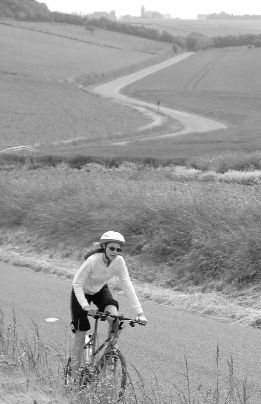
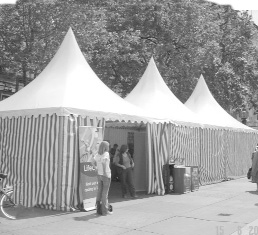
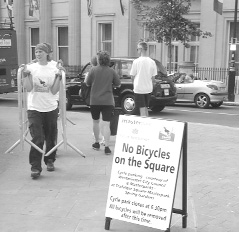


 Next year, an altogether better option might be to join one of the World Naked Bike Rides, which tend to be urban events, and thus more easily accessible. Strangely, WNBR has received zero coverage in the cycling media, something A to B hopes to correct, with contributions from Spain (mainly bottoms), The Netherlands (rather formal, and exclusively male), and the USA (exuberantly uninhibited, as one might expect).
 Er, yes. In 2005, they’re hoping to organise 1,000 rides. Perhaps they should hijack the London to Brighton? A bit more entertaining for railway staff, anyway.
 But nothing is simple these days. National rail posters have to be cleared by the Strategic Rail Authority, Association of Train Operating Companies and each of the 25 railway companies, reducing even the most inspirational design to a committee-inspired shell, and the artist to a quivering wreck. Sure enough, the first draft was deemed ‘insufficiently off-peak’, the second contained ‘too many bicycles’, as did the third.The fourth had ‘no visible safety fencing’, the train ‘didn’t look like a real train’, the station – you guessed it – wasn’t a real station and there were too few pedestrians. Finally, and most ludicrously, ATOC felt the poster was putting too great an emphasis on ‘touring in the countryside’ – the raison d’être, surely? The great names of British railway poster art must be turning in their graves.
 One is increasingly reminded of just how odd the world has become. Few people would have predicted Gaddafi’s denouncement of terrorism, let alone an invitation to all and sundry to fund railway lines across the Sahara. Even fewer, one assumes, would dare predict that the erstwhile spoon-bender Uri Geller might launch a folding bicycle.The ‘Uri-Bike’, marketed under the rather unfortunate slogan ‘Bend it-Bag it’ is in fact, more or less identical to the existing ‘Bike-in-a-Bag’. The only real difference is that the 20-inch, 6-speed Bike-in-a-Bag sells for £240, while the 20-inch, 6-speed Uri Bike sells for £300. To be fair, Uri is throwing in a Reevu helmet with every purchase, plus the sort of endorsement that only an erstwhile spoon-bender can provide. This bike, one assumes, will only bend if the rider concentrates very hard.
 On the other hand, cycle helmets appear to be of dubious value. For an example of just how detached from reality the pro-helmet campaign has become, we must thank reader Jean Elliot of Upminster, who provides a cutting from the Romford Recorder. It seems young George Stokes of Romford has narrowly escaped serious injury after being struck by a lorry while crossing the A127 Southend Arterial Road on his bike – a most regrettable incident, and one naturally wishes the young man a rapid recovery.


 The real problem is that no-one has yet dreamed up a practical way of refuelling a vehicle of this kind, so filling stations are a bit thin on the ground. The general consensus is that robot actuation will be required, as the risks of (a) some clown blowing up the immediate neighbourhood or (b) inflating his jacket and floating off into the stratosphere, are not insignificant.
 For 2003, Stuff invited alternative transport manufacturers to display their wares in a ‘Stuff the Congestion Charge’ zone. Thus, the bicycle world was represented by Brompton and Airnimal, two suitably techie folding machines, plus the single speed Bike-in-a- Bag; arguably less techie, but useful enough for the young man with neither money nor sense.


 Take the railways, for example. Party A franchises services to a shambolic collection of bus companies, French mineral water magnates, and get-rich- quick operatives, handing the infrastructure to privately-owned Railtrack, which boasts that rail hardware will last 100 years, and concentrates on building profitable retail outlets instead. Within ten years, the network falls apart, sending Railtrack spinning into a black hole.Yet somehow, this raises barely a murmer, because no politician is willing to admit that whole process was fundamentally flawed.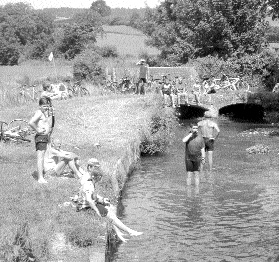
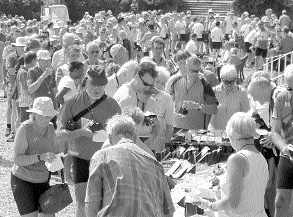

 At the Bike Show, a selection of nefarious stall-holders were hard at work pocketing wads of cash from young men of this kind. One such outfit was Ebryo Scooters, purveyor of a monstrous electric scooter known in its country of origin as the Flying Dragon, but repackaged as the ‘Street Runner’ for the UK where dragons have less relevance in marketing terms.
 Without exception, the select band of US A to B readers (literally one in million on the statistical evidence) prove to be a delightfully charming and urbane bunch. This is fortunate, for at Round*Up they find themselves face to face with a group of equally pleasant, but distinctly potty foreigners, who mostly appear to be intent on selling them folding bicycle trailers.

 Should one have time to kill in Philadelphia, the SS United States is well worth a visit. Built in the 1950s, just a decade before the horrors of air travel destroyed the elegant liner trade, the vessel is a rare survivor.Withdrawn from the Southampton to New York run in 1969, she changed hands a number of times, circling the world from shipyard to scrapyard and back, as each project foundered. Finally, stripped to the bones internally, the great liner came home and has been moored on Philadelphia’s Delaware River ever since, awaiting restoration… or the scrapyard. One hopes that one of the various projects will eventually succeed.
 But enough of what might be, for we must journey to Scotland, which is visibly pulling clear of our increasingly dis-United Kingdom in transport terms.The latest innovation from north of the Border is a pro-cycling advertisement:Thirty seconds long, the film makes a mockery of those annoying car ads where square-jawed young fellows get the crumpet by driving much too fast on remarkably empty roads. In this memorable example, our hero takes to commuting by bicycle, arriving faster and very obviously getting the crumpet in the shape of a pair – no less – of voluptuous cycle courierettes. Cycle commuting has been on the rise for some years in urban Scotland – up 38% in Glasgow and 65% in Edinburgh during the 1991-2001 census period. Just watch it accelerate now.


 The mention of dubious cycle paths in the last issue brought forth an entertaining crop of poor facilities. The Mole’s personal favourite hails from the Georgian pile once known simply as Brighton, but now, one understands, reborn as Brighton & Hove City. In a rambling aside, one wonders whether the town formerly known as Brighton will be constructing a smart new cathedral to match its city status? If so, one wonders whether the good burgers of the metropolis will incorporate any of the fine ironwork from the pile of flotsam formerly known as Brighton West Pier, which got wind of the city tag back in January, and promptly fell into the sea.
 In the interest of fairness, the Mole has carefully selected positive role models of both the male and female variety. Such images require little in the way of explanation, although in passing one appreciates how dancer and popular musician Geri Halliwell acquired the fine pair of legs, but how might evolutionary theory account for the manly chins of Formula One racing drivers? A by-product of unnatural G-forces, perhaps?
 But just a moment – is this cheerfully helmet-less David Coulthard the same Formula One racing driver who has recently become patron of the Bicycle Helmet Initiative Trust? A well-meaning, if slightly potty organisation lobbying hard (against overwhelming evidence) to make bicycle helmets compulsory? According to the Bicycle Helmet folk, David is a keen cyclist who, ‘cycles almost every day in Monaco as part of his training regime and always wears a helmet himself.’


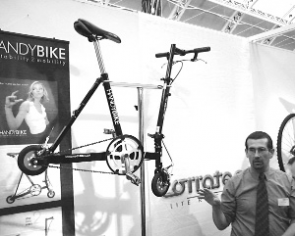

 All manner of sporty types tried their hand on this infernal machine, including cycling’s Mr Big, the Rightly Honourable Steven Norris, formerly a Tory MP, but now a professional transport lobbyist, supporting cyclists, motorcyclists, motorists, and any number of other ‘ists’, for a modest remuneration. Unlike the Lycra-clad types, Mr Norris proceeds to ride the Marin County Downhill Course at a nice steady A to B pace, as one might expect from a fellow with a reported loathing for bilious Lycra and daft cranium helmets. In any event, Mr Norris makes no secret of the fact that he finds exercise in other ways, and quite right too.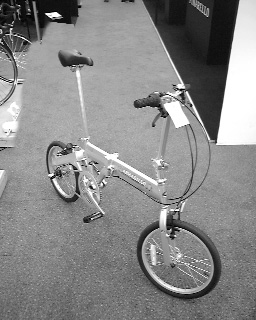
 Airframe probably had the nicest stand in the show – well lit, exquisitely designed, and displaying some cheerful- looking Airframes in a variety of fruity colours. One wishes the bike well – the wibbly- wobbly frame will not appeal to all, but the rideability and general sporty stance of the bike should produce sales. According to one seasoned observer, the bike actually rides better than the Birdy… it’s also somewhat cheaper.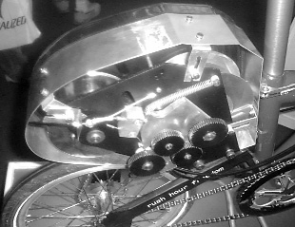
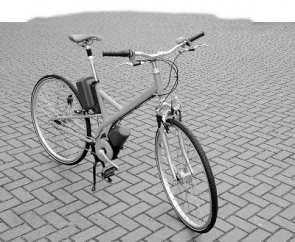
 The other crank-driven newcomer is the Oxygen, an Italian bike marketed in the UK by Pedal & Power of Chester. Like most Italian products, Oxygen marketing involves delightful young ladies wearing very few clothes. The Mole reproduces an example for the general good of cycling (see A to B 31), and yes, one appreciates that she couldn’t possibly cycle in those heels.
 The favourite amongst the Telly-Tubby fraternity was, as usual, the Like-a-Bike. These little wooden machines were underfoot throughout the show, despite the best efforts of the BDC’s burliest security guards. Sunday’s photo-shoot resulted in predictable chaos, when five diminutive riders converged on the A to B stand, through, between and under the crowds.The photo session was followed by a visit to the test-track, where a remarkably talented two-year-old led the field, but was pipped at the post when the A to B man took the inside line.
 Amongst the most interesting products at CYCLE 2002 was the ‘Ultimate Folder,’ brought over from California by Len Rubin to illustrate his lectures at the show.This machine is a Brompton- clone constructed almost entirely from titanium. Even with a 14-speed Rohloff hub, weight (without pedals) is 9.4kg, or a little over 20lb.The bike rides well and feels rigid, with the exception of the handlebar adjust mechanism – one of the few components that wasn’t made of titanium.