FIRST PUBLISHED April 2005
Strategic Rail Authority, Association of British Drivers, Merc folding bike
Good news from Bogworthy Junction! The much derided Strategic Rail Authority has finally been abolished, but not before dropping, as a parting bombshell, that services to Bogworthy will be downgraded in the new Greater Western Franchise. But at least we have seen the back of an organisation that was neither Rail-friendly nor Strategically-minded.The bad news is that most of the staff are expected to transfer to the Department for (Road) Transport and continue mishandling rail matters from there. Still, one assumes that the forces of the state know what is good for us.
Most trains these days have space for only two to four ‘cumbersome’ machines, and long-distance travellers are generally obliged to book ahead. Once upon a time, this was done by speaking to a humble, but knowledgeable, railway clerk, who would transfer the information to another similar bod in the bowels of railway HQ, who presumably signed a chit or stuck a Post-it note on a giant map of the network. However it was done, the system worked reasonably well until January 2005, when modernisation resulted in the new, and fearsomely powerful, National Reservation System, costing a staggering £80 million. Booking has since become a hit-and-miss affair, particularly when crossing network boundaries with a bicycle.
To provide just one example, the little train for Kyle of Lochalsh, which carries two bicycles, recently pulled in to Inverness, where no fewer than ten cyclists were waiting, reservations in hand. Eight of the ten weary cyclists travelling that day had already been crammed into six bicycle spaces on another train.

Merc Folding Bike
Regular cycle/rail commuters are buying folding bikes in droves, and who can blame them? But these days, folding bikes might not be all they appear to be either. The Chinese have developed some serviceable nuclear weapons, and shot all manner of dangerous things into space, but the finer points of folding bike technology continue to elude them. The latest arrival from the east is the Merc, a straight copy of the Brompton. This sounds great news for consumers, being made of aluminium and very pretty to look at, but the reality is something of a disappointment. As one understands it, aluminium is lighter than steel, but for reasons that only the boffins are able to explain, the aluminium Merc weighs a hefty 13.2kg, and is thus significantly heavier than the steel Brompton. The Mole took the opportunity to ride one of these faux-Bromptons at the CTC York Rally and found all sorts of oddities in the handling, brakes and folding. A bit of a dodgy purchase at £499 then, but is the company really allowed to sell such blatant copies? As with so much in and beyond the Euro-zone, the answer appears to be yes and no. Merc bikes have been seized and impounded on the European mainland, where copyright laws are interpreted in a relatively protectionist manner, but not in Britain, which adopts a more laissez-faire approach.
Surely the Merc is a straight copy, passed off as a Brompton, bringing only some rather heavy aluminium to the party? Even the Merc instructions are copied from the Brompton handbook. And if the frame is wobbly and the brakes dangerously weak, surely the bike must fall foul of British Standards too? It seems not, or at least Trading Standards has made no move to prevent the open sale of the machines.
 The road lobby isn’t all it might appear either! Road interests are advanced by something called the Association of British Drivers, a hang ’em, flog ’em and run ‘em down operation, composed largely of middle-aged men of the kind that wear trilby hats and grip the wheel with chamois leather driving gloves. Believing in broad terms that motoring should be fast, cheap and convenient, the ABD lobbies hard against speed cameras, taxation and road pricing, as one might expect. But Mark McArthur-Christie, the ABD’s Road Safety spokesman appears, to have gone native! After riding a Dawes Galaxy to work and rather enjoying the experience, Mark ‘didn’t bother’ replacing his car when it was written off, and is now car-free. ‘If I absolutely need a car, I hire it’, says the ABD man. For National Bike Week in June, he went a step further, organising a car, bike and bus Oxford commuter challenge.
It’s an odd world: Strategic Authorities that offer no strategies, Bromptons that are not Bromptons and now car lobbyists without cars. While the bearded, sandal-wearing anti-road types arrive at demos by car, the bicycle in the bushes could well belong to the ABD man behind the bulldozers, or perhaps even the chairman of Shell (see previous issues), should he happen to be passing. In the era of Peak Oil, one would be well advised not to jump to any conclusions.
So where is personal transport heading? Celebrities are flocking to folding bikes as never before: in the old days, if you pulled up beside a vaguely familiar face on a Brompton it was almost certain to be Adam Hart-Davis or Simon Calder.These days, it might be all-purpose celeb Jerry Hall, former boxer Chris Eubank, Member for Bath Don Foster, or Tory something-or-other Bernard Jenkin MP. The latest convert is television presenter Kevin McCloud, who felt sufficiently strongly to order Bromptons for himself and two other directors of his production company.
Incidentally, Strida enthusiasts include film maker Spike Jones, Radio 4 presenter Libby Purves, racing champion Stirling Moss, and the Queen’s nephew Lord Linley.

At the more vulgar end of the transport scale, it seems Hummer owners are enthusiastically signing up for the new SYNus, which sounds like a nasal problem, but is actually an ‘urban command centre’. According to manufacturer Ford the SYNus is a ‘mobile techno sanctuary sculpted in urban armour and inspired by the popular B-cars of congested international hotspots’. In practice, this means it’s a security truck, complete with steel shutters that rise up to shield the windows, and deadlocks to disable the doors. Lock your keys inside and you might as well start saving up for another one. Lock your dog inside on a fine summer’s afternoon and the poor chap will be done to a crisp by the time they cut him out.
…such everyday accessories as bullet-proofing, a mini safe and infrared night-sight…

But as one rather suspected, the SYNus is a mere runabout. Meet the $225,000 Bad Boy Heavy Muscle Truck, a post-apocalyptic urban nightmare, based like the Hummer, on US military hardware, but in this case on the rather larger Medium Tactical Vehicle. The Bad Boy weighs six tons, stands ten feet tall and can be ordered with such everyday commuter accessories as bullet-proofing, a mini safe and infrared night-sight. The $750,000 ‘NBC’ version offers protection from ‘dirty’ nuclear bombs and biological agents. Fuel consumption is a little under 8mpg, which sounds rather good, all things considered. The Mole is waiting for the civilian version of the Chieftain tank.



 Most of our friends were agreed on one thing when Alexander arrived – we might previously have lived a car-free lifestyle as rootless ‘dinkies’, but all that was going to change. Sage nods all round.


 Riding a bicycle is getting easier and more reliable.With puncture-resistant tyres (page 24), drum brakes (page 22), a cargo trailer (page 32), and power-assist (page 27), almost anyone could transfer their family shopping from car to bike.Yet the number doing it in the UK can be counted in thousands (maybe hundreds) rather than millions. Why? We’re partly to blame, because we’re obviously failing to get the message across to ordinary people. But if you were to demonstrate this sort of technology outside your local supermarket, people would wave their hands at the sea of cars and blame ‘road safety’.They’d be right, of course. Bicycles may be easier to use and more reliable than ever before, but the perception is that roads have become dangerous places.Will this trend be reversed? Absolutely no idea, but we’re trying to plant the seeds of a revolution, and once a revolution begins, it’s often unstoppable. If a single TV chef can change attitudes to the way children eat, surely the same can be done for the way we get our food home, or the kids to school?
 Puncture proof? Well, not exactly. As Schwalbe carefully points out, ‘…like everything in the world – this tyre isn’t indestructible. But against the typical tyre killers that everyday cyclists encounter, like pieces of broken glass, flints and small thorns, it’s the best protection we could devise…’
 Puncture-proof?
 will give some peace of mind, although at £23.99 each, they’re quite a pricey option.The Marathon Plus is available in all the common sizes, down to 47-406mm (20-inch). Schwalbe is planning to release a 349mm (16-inch) version soon, bringing this sort of puncture technology to compact folding bikes too. Performance gets a bit trickier to predict in the small sizes, but if the 20-inch tyre is anything to go by, performance should not be greatly affected.
 ORIGINAL ARTICLE FROM JUNE 2005. The Roo EL went out of production some years ago. Dahon has since tried other variants based on different power systems and bikes, but none has been very successful
 Top assisted speed was 14mph in theory, but the weak motors meant pathetic hill-climbing and assistance that more or less dissolved above 10mph, giving a lethargic average speed of 10.8mph. Range, from the tiddly battery, was just ten miles. In other words, you really were better off with a conventional Dahon and the near-thousand pound surplus in the bank, earning lovely interest.

 This is essentially a standard Dahon folding bike.The handlebars drop down, and the frame folds midway along, sandwiching the bars between the two frame halves. Like most 20-inch Dahons, the Roo come with a little magnet and plate to hold the folded bike together, but in our experience, it’s only possible to get the plates to touch by leaving the handlebars up. On the EL, the width problem is compounded by the large Sparc control switch, which fouls the frame. Dahon claims folded dimensions of 81cm long, which we’d agree with, 56cm tall, which can only be done by removing the seat pillar, and 28cm in width, which is a ridiculous claim, or at least, we’d like to see how they do it, because we can’t.These dimensions would give a folded volume of 127 litres or 4.5cu ft, which just isn’t attainable.


 These days (touch wood) the best folding bikes are pretty reliable, clocking up a similar mileage between failures to a conventional bicycle, but wheel rims and spokes can still cause problems on hard-used small-wheelers.We’re not sure why the spokes suffer, but most of the problems with rims are caused by the brakes. A 16-inch rim has little more than half the braking area of a big wheel, so it can overheat on long descents, and will wear out at least twice as fast.Worn rims can be dangerous, but even if they don’t disintegrate, rebuilding a wheel can be a time-consuming and/or expensive process.

 After buying two Bromptons I found myself with rather a lot of bikes, and was able to compare their performance on my regular commute on the Atlantic coast of France. I live in Hennebont and commute through the town of Lorient to my office on an industrial estate ten kilometres to the west. My conclusions aren’t rigorously scientific, but I have corrected for differences in cycle computers and only included simple rides on the same route, without detours for shopping etc. I have also excluded exceptional weather conditions (strong winds, ice, etc) and night rides (some bikes have dynamos and some battery lights).


 Weekly shopping usually consists of small mixed items, and if you travel by bike these can usually be packed into a rucksack or panniers. Larger items can be more awkward to transport – I think the largest item I have carried strapped to the top of my pannier carrier was a king-size duvet. It was big, but light, so it didn’t effect the handling too much. Heavier items like bags of compost, cement, plaster, barrels of beer (needed after all that digging and cementing), televisions, beehives, and broken microwaves can’t be safely strapped to the rack… Or at least, not all at once.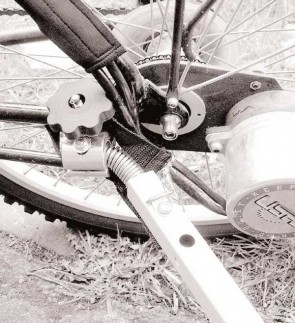

 Getting from A to B is a serious business for Americans. Look at the success of Driving Miss Daisy. To be a True American, there are certain beliefs that one must accept. Here are some of the big ones:
 We’re a little late this time, but we know you will forgive us. Brompton has introduced a whole range of new bikes and by waiting a week or two, we’ve been able to bring you exclusive tests of the lightweight S2L-X and fully-equipped P6R-XDL, plus reviews of the all-new Mezzo i4 and the not-quite-so-new Hase Pino recumbent. With all this excitement, we’ve had to cut just about everything else, so there’s plenty to look forward to in issue 48, including puncture-proof tyres, drum brakes and all the usual tests.

 The first decision for those contemplating a gear upgrade is to calculate the sort of gears they want. Using Brompton’s 50- tooth chainring and the new Highpath sprocket set (£39.50), the standard gears of 40″, 46″, 55″, 63″, 75″ and 86″ become 33″, 46″, 50″, 62″, 68″ and 93″ – in other words, the high gears are higher and the low gears lower. Note that the fairly even spaces of the original have been lost, but as with the Sturmey Archer 8-speed (see A to B 40), we now have broad gaps at the extremities and narrower spaces between the middle gears, which can be useful.


 Crikey. This is all beginning to sound a bit like the comedy sketch (one of several) where the innocent man goes into the shop and asks for a record player, and is mercilessly ribbed by the spotty youths behind the counter. Ask for a folding bicycle these days, and you’ll be laughed back onto the pavement: ‘With or without the titanium crown-fork assembly, sir?’ ‘Hub, dynamo or battery lights?’ ‘Pentaclip or traditional clamp?’ P-type bars?’ With or without Stelvios?’ And so on through the gear options, ad infinitum.
 Which brings us to illumination. If you’ve had enough of seized dynamos, broken wiring looms and faulty bulbs, the lighting package on this bike should help to get your night-life sorted.The rear lamp is the familiar stand-light version of the Basta LED used by Brompton for several years, while the front is a Basta Ellipsoid halogen.This pair are powered by the new narrow version of the SON hub dynamo, designed specifically for small- wheelers.This delightful thing is controlled by an equally small (and rather inaccessible) switch on the back of the front light.
 With Brompton’s mix-&-match policy, published spec gives no more than a guide. If you don’t want the SON hub dynamo, you can choose a lighter bottle dynamo, or battery lights, or all three, or nothing. Similarly with luggage: the P6R-XDL will accept any of Bromptons range of four front quick- release bags, although there is a one small proviso with this handlebar pattern: if you fit the front battery light, it will be obscured by all but the new lower S-bag.
 For the rear rack, Brompton and Radical have come up with a neat bag which – in marked contrast to the S-bag, which has a tardis- like interior – looks huge, but holds only 17 litres (slighter more than the old Pannier bag, but rather less than the Touring bag). That said, it more or less doubles the bike’s carrying capacity, so it will have its uses.
 Otherwise, we’re well into Moulton/Bike Friday territory; machines that can’t compare folding-wise, but offer legendary performance. In this company, the real strength of the P6R-XDL is that it combines the folding ability of the Brompton with reasonable weight and decent equipment. The feedback we’ve had is that professional users wouldn’t go for the P-type bars (‘not really that keen’) or the lightweight components (‘didn’t notice it’). But in this market, reliability is paramount, so users will happily pay big money for such extras as SON hub dynamos, hub brakes (not yet an option) and puncture-resistant tyres. It seems the professionals will choose their own spec from the long list of options. Our prediction is that they won’t go for the P6R-XDL, but for cycle tourists, reduced weight and alternative riding positions are more important.

 Something has been up at Brompton for months. Little snippets of information have leaked out, but the dead giveaway was the report that a group of Russians had been spotted in the Brentford factory discussing strange grey metal objects. They obviously weren’t selling vodka, said our contact. The metal could only be titanium, and the Russians just had to be negotiating to supply it. It turns out that the rumours were largely true – Brompton has made arrangements for the fabrication and supply of a number of titanium parts from both Russia and China (you can’t be too careful these days). Initially, these parts will be fitted to a range of new expensive models, but the technology should gradually trickle down, bringing a new era of lighter, more durable folding bikes.


 We always do our best to concentrate on the practical aspects of cycling. Can you ride it to work (and carry it into the building)? Can you take the children to school on it (or in it)? Can you take it on holiday? Does it fit in a car, train, bus or plane? As a consequence, we tend to come back again and again to the same solutions, because certain bikes, trailers and other bits and pieces are so damn practical. It also means we ignore all manner of wacky and wonderful things – many of them recumbents. As a general rule, if it won’t fit in our bike shed, it’s unlikely to fit in yours, so we leave it to the more – how shall we put it – esoteric publications. You know the ones.
 Quite why anyone would choose to travel like this is a bit of a head scratcher.There certainly are a few key advantages over an upright tandem or trailer bike. Firstly, you can keep an eye on the child, which makes these machines popular for carrying disabled children. Secondly, the laid-back passenger probably helps to smooth the flow of air round the machine (but with frontal area similar to a conventional upright bike, don’t expect to break too many speed records).The disadvantages are that it’s an expensive beast (£2,315), and a cumbersome one, although in recumbent tandem terms, the wheelbase of 1.4 metres and overall length of around 2.4 metres (two metres in child-carrier form) are not particularly long.