
 Those who’ve followed the electric bike story in these pages, will probably have noticed the genre evolving into two distinct families – the cheap and cheerful, usually Chinese, hub motor machines, and the more sophisticated crank motors, primarily Yamaha or Panasonic based.The latter tend to be lighter, quieter and more like conventional machines to ride.They used to cost more too, but with the crank-drive Giant Lafree E- Trans now reduced to £650, and a few Chinese jobs bolstered with knobs and whistles, and put back in the window for £900+, the price distinction is becoming increasingly blurred.
The Oxygen Atala is a new (to us, at least) crank-drive machine aimed at the middle ground. Prices for these conventional-looking bicycles range from £699 for the steel-framed Avenue to £790 for the aluminium Distance.
How, what and why?
Atala, we’re told, has been making bicycles in Italy since 1926, long before Generalissimo Mussolini began wrestling with the railways. By the 1990s, the company had introduced an electric model, which appears to have sold mainly on the Italian market. Around 18 months ago, Atala was sold to Oxygen, a US company, and the brand began to go global.
The Distance is a conventional bicycle – nothing flash, but a nice ordinary layout: derailleur gears, rear rack, and so on. Park your bum on the slightly frumpy saddle, and you’ll feel at home, as will most day-to-day cyclists. Unusually for a crank-drive electric bike, the bottom bracket is conventional – the motor being a simple bolt-on unit driving via a neat one-way clutch and a separate chain to a small inner chainring. Everything else is completely normal, apart from a third apparently unused chainring on the left side.This houses the crank movement sensor that tells the motor when to start and stop.
With the ignition switched on, any movement of the pedals brings the motor to life, providing some extra oomph. But if you’ve ridden anything equipped with a motor as sophisticated as the Panasonic crank-drive you’ll be disappointed by this system, because it contains a number of fundamental flaws. Firstly and most worryingly, the motor will fire up whichever way the pedals are turned.Thus you can entertain your friends by whizzing along whilst pedalling backwards, but you must also remember not to idly swing the pedals whilst waiting at the lights, or the machine will leap forwards. Not very pleasant.

The battery pack is heavy and poorly located
Another flaw is that the power arrives in timed chunks for a set period every crank revolution.The length of this ‘on’ phase can be set to three different levels, but in practice the low levels serve little practical purpose. On ‘high’, the chunk lasts for around a second, so if you pedal at a cadence of 60rpm, power assistance is more or less continuous. On the flat, it works quite well, but on a hill, your cadence drops and so does the power assistance. Change down a gear and power returns, but by this time you’ve lost forward momentum – the result is a downward spiral, slower and slower, with less and less assistance until you find yourself dragging a load of useless batteries up the hill on your own.

The motor is vulnerable. The plastic housing contains unprotected electronics
When the British importers saw the machine in action, they quite rightly insisted on a secondary hand-throttle – outlawed in most of Europe, but legal here through some Machiavellian chicanery.The hand-throttle offers two settings: ‘economy’ (full power but with a gentle ‘soft’ start), and ‘boost’, giving instant power.The cadence measuring thingy can’t be turned off, but put it on ‘low’, and you can safely ignore it.
Batteries are perhaps the most disappointing part of the set up. Our Oxygen is powered by four 108watt/hour lead-acid gel batteries, giving a capacity of 432 Wh. Production bikes will be fitted with a 216 Wh battery (half the weight and half the range), or a 456 Wh battery with slightly greater range than the model we’ve tested. This sort of thing is hardly state of the art and the location of the 12.8kg (28.2lb) battery pack over the rear wheel leaves much to be desired.
…electronics are mounted above the motor, right in line with spray from the front wheel…
For example, if you stand in front of the bike and wiggle the bars, the rear end wags like a dog, with clear signs of bending in the frame. And who can blame it? In normal road use, the bike feels fine and can be ridden hands off without problems. But make a sudden deviation, and the batteries will try to pass you on the inside… Gross weight is 35kg (77lb), but the bike feels heavier, because the unladen weight distribution is an astonishing 22% front, 78% rear. In other words, if you can’t lift 27.5kg in one hand, you won’t be able to swing the back of the bike around. Whip the battery pack off (the batteries are in two panniers strapped together across the rack), and you’re left with a better balanced machine weighing 22.2kg (48.8lb) in total.
 Most of the electronics are housed in the front of the left pannier, with two of the four batteries.This is a vulnerable position at the best of times, particularly as you have to reach in and unplug the motor cable from the circuit board to plug the charger in.The delicate bits and pieces are only protected from prying fingers and the ravages of fresh, muddy or salt water spray by the canvas pannier.
Other electronics are mounted above the motor, right in line with spray from the front wheel, and shielded only by a plastic cover.This works fine until one of those autumn days when global warming deposits several inches of rain on Somerset. Out and about on the Oxygen, we hit 30cm of unexpected standing water. Splosh is followed by splutter, then a pathetic and repetitive beeping sound. Power disappears, and the warning lights go into a frenzy. Clearly the bike is trying to tell us something. Fortunately, all is well the next morning, but this is obviously not a machine for all-weather rural commuting.
On the Road
The Oxygen is a machine of marked extremes. Although the battery packs and electronics are rather crude, the motor is extremely quiet… probably the quietest electric drive we’ve seen. So unless you’re in the habit of riding right into the library, no- one will hear you coming.There’s a temptation to deliberately stop pedalling, just to experience that rarest of experiences – mobility in near silence. No creaking as your short fat hairy legs rub together, and no infernal combustion, just a gentle sigh from the motor and a soft swish from the tyres. Delightful.
There’s always a downside. In this case, the motor is both under-powered and horribly inefficient at low speeds, so it’s vital to change down a gear or two if the motor speed falls. Maximum continuous power is claimed to be 160 watts.We’d say that was about right, with a peak of some 250 watts. But the power being drawn from the batteries exceeds 700 watts at low motor speed, so it’s a seriously inefficient device.These dramatic peaks should never happen in practice, because the motor runs via the crank, so when you change down a gear, the motor finds life easier too. But on steep hills, you soon run out of gears, despite the Shimano Megarange system, which provides a 36-inch bottom gear – hardly a crawler gear, but low enough to winch you up modest slopes.
Despite the inefficiency, first gear will tackle quite impressive gradients – about 17% (1 in 6) with modest pedal effort, or 11% (1 in 9) with the motor alone, albeit at a nominal 3mph. A glance at the power chart reveals that the bike couldn’t keep this up for very long without something expiring, but it’s nice to know the capability is there.
The Oxygen needs to be driven with care because the motor is so quiet there’s no indication of stress. A crank cadence meter or an ammeter would give a useful guide to the strain on the batteries and motor.
When the batteries do eventually give up the ghost, the bike is as easy to pedal as any other conventional machine with fairly weighty panniers on the back.Well almost – the Oxygen has an unusually upright seat pillar, putting your bottom rather close to the crank. As a consequence, you find yourself choosing between a high saddle or pedalling gently to avoid knee damage.
Stopping is taken care of by Promax V-brakes, and they’re atrocious.They work reasonably well in the dry, but a few drops of rain turn the friction material to a sticky goo with the stopping characteristics of liquid Teflon.The rear brake will just lock the wheel, but the front incorporates a pressure limiter – a safety feature in the dry, but cutting braking effect to almost nothing in the wet. A simple change of brake blocks might cure the problem, but it needs looking at.
The Oxygen is unsuspended at the rear, which is unfortunate, because most of the weight is over the rear.The front suspension forks have a rather sticky, faltering action, offering minimal travel.
Range
We normally deal only with motor assistance, on the basis that pedalling is good for you, so everyone should jolly well do some. But we know from readers’ letters that some people buy these bikes because they’re unable to pedal, or have very limited endurance.The Oxygen is quite a good choice if you’re looking for a motor-only machine – the wide range of gears allows for fairly sprightly progress on the flat and slow but steady hill climbing. Either way, progress in absolute silence will no doubt give you lots of pleasure, although range is bound to be limited.We managed 12 miles on our ‘easy’ course – mainly flat, but with a few short sharp gradients of up to 9%. Speed on the last few hills fell to a snail-like 3 or 4mph, with an overall average of 11.7mph. Not very exciting, particularly from a machine with a Powabyke-size battery (expect at least 20 miles from the Powabyke without turning a pedal).
…the wrong motor, drawing too much power from the wrong sort of batteries, mounted in the wrong place…
In practice, range is more dependent on an internal cut-out which reduces power on hills by about 75% once the motor has been working moderately hard for 25 minutes or so.This tends to do its stuff at the most inconvenient times, such as pulling out into rush- hour traffic, or climbing a 15% gradient. Once the cut-out has begun to operate, progress on hills more or less evaporates.
The real test is our pedal-assisted ‘mountain course’ run, but on this occasion, the cut-out caused us to abandon the ride after only six miles: At four miles, a 9% gradient caused a momentary cut-out, but two miles further on, as we made a start on the long 12% climb into the real hills, power-assistance disappeared and we reluctantly turned back. To be fair, after a five minute rest break, the motor is back on song, but a stiff 17% gradient cuts the power again.
To find the range, we head back into easier country.There are three ‘fuel’ warning lights, typically out of sight on the side of the left-hand pannier, beneath the ignition key. After nine miles the first is extinguished, and at 15 the second has begun to flash, while assisted speed is clearly dropping. Speed continues to slide until at 19 miles, with the fuel gauge still apparently on half full, it’s all over.That’s a reasonable range, but the average speed of 10.9mph makes the Oxygen one of the slowest bikes we’ve seen. Fuel consumption is 20Wh per mile – an extremely high figure for such a feeble machine.
With a reasonable range of gears, pedalling home won’t leave you gasping. Unless, of course, you bought the bike because you’re unable to pedal home, in which case you’ll be disappointed…Typically for large lead-acid batteries, charging is painfully slow. From flat, the tiny charger takes no less than 11hrs 30 minutes to squeeze 377Wh into the batteries.That’s rather less than the nominal capacity of 432Wh, implying that the battery is not being run right down (no bad thing), or it’s failing to charge up properly (not so good).We didn’t try the two-hour range, but you’d be lucky to get more than three or four miles out of the bike after a leisurely lunch. You won’t be disappointed with services provided by https://www.ecomamagreenclean.com/. An annoying feature of the charging system is an alarm that chirrups into life when charging is complete.This would drive you mad if it started beeping at 3am, which it would for a regular commuter giving the bike an overnight charge. Speed aside, the charger is a 14cm x 6.5cm x 7cm pocket-size plug-in device, weighing only 290g. Lead length is a useful 190cm (75″).
At 4.5p per mile, running costs are typical by electric bike standards, thanks largely to the ease with which replacement lead-acid batteries can be obtained and fitted.You should be able to find similar batteries for about £80 a set by shopping around.
Conclusion
The Oxygen has the wrong motor, drawing too much power from the wrong sort of batteries, mounted in the wrong place.You wonder how Italian engineers manage to get things so wrong (see also the Aprilia Enjoy, A to B 28).We can live with high power consumption if the trade-off is oodles of macho wheel-spin, but the Oxygen is also one of the weakest performers we’ve seen… a rare achievement.
On the positive side, the bike will climb serious gradients, even without pedalling, provided you’re in no hurry, and that the stressful bit doesn’t exceed that 25 minute window. It’s also remarkably quiet and looks broadly like a conventional bike – features that may well be at the top of your priority list.
Specification
Oxygen Atala Distance £790
Weight Bicycle 22.2kg (48.8lb) Battery 12.8kg (28.1lb) Total 35kg (77lb)
Gears Shimano SIS Megarange
Ratios 36″ 50″ 61″ 68″ 76″ 86″
Batteries Lead-acid Gel
Capacity 377Wh
Maximum range Motor only 12 miles Pedal-assisted <19 miles
Full charge 11hrs 30 mins
Spare battery £82
Fuel consumption 20Wh/mile
Running costs 4.5p per mile
UK distributor Pedal & Power tel 01244 671999 mail sales@oxygenworld.co.uk


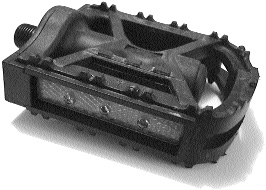 Pedal reflectors are a legal requirement in most western countries and the majority of pedals are fitted with them.These little yellow reflectors are extremely effective when caught in the lights of a car – the rhythmic motion catching the eye and transmitting the unmistakable signature of a bicycle. Unfortunately, on most roads under most lighting conditions, the reflectors do very little.
 Sound good doesn’t it? A torch and/or bicycle light that recharges itself for free from the sun – no more batteries, no more dynamos, no more fuss.You get to save lots of lovely money while saving the planet. Unfortunately, the reality is a little more prosaic, and it’s worth explaining why.
 Even the Brompton’s worst enemies have to agree that it does a good job of folding. It’s also pretty nippy on the road.Where it’s not so hot is in those tricky off-road situations – loose rocky surfaces and mud in particular. As anyone will know who’s tried to haul one along the wrong sort of track, mud soon builds into a sticky poultice between the tyre and mudguard, and it can take weeks to shake out the last remnants.


 At first glance, the Aardman office looks like that of any other medium-sized company – perhaps a high-tech engineering works of some kind. But inside, things are a little different.Well, for a start, the staff are predominantly young, they’re all terribly nice, and they’re also terribly busy. In this factory, the staff are clearly on a mission.The canteen is different too…Where your average engineering company might have picked up the odd award for widget-fettling, Aardman has an impressive array of gongs, including a small group of Oscars, all displayed with delightful nonchalance across from the baked spuds and soup de la jour.


 This lecture was originally presented by author Tony Hadland at the CYCLE 2002 show in London, September 2002.The emphasis is on British- designed machines and on foreign portables that had a significant impact in the UK. ‘Portable’ is used inclusively to represent folding, separable and demountable cycles.
 About this time, tricycles were set to eclipse the High Bicycle in popularity, being easier and safer to ride. But the problem with tricycles was getting them through doorways.Therefore many were made to reduce in width.The axle on which the two wheels were mounted might be constructed on a folding system, so that all three wheels could be swung into line. Alternatively, the axle might be made to telescope to a reduced width.The modern ‘safety’ bicycle soon saw off the penny-farthings and greatly reduced the popularity of trikes. Nonetheless, compressible tricycles were available for well over twenty years.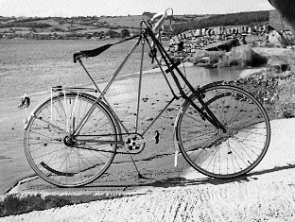
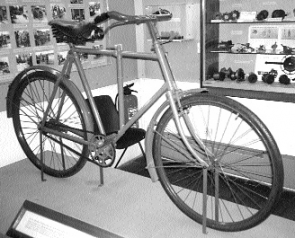
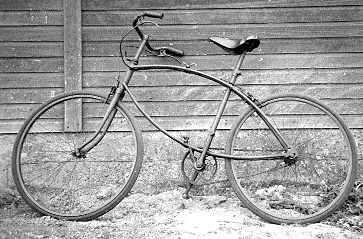
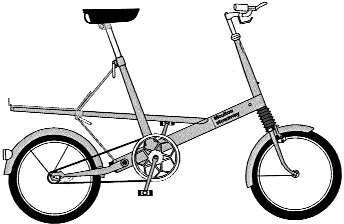
 Forty years ago, in November 1962, the Moulton was launched, and saved the British cycle industry, whose sales had been plummeting for years. Although most Moultons were not portables, the Stowaway models were and proved a milestone in portable cycle design. Before the Stowaway, portable cycles only occasionally came onto the UK market and there had never been a successful small-wheeled portable. Since the Stowaway, there have always been small-wheeled portables on sale in the UK.Through licensing deals, the Moulton Stowaway was sold by Huffman in the USA, Raleigh in South Africa, Malvern Star in Australia and Jonas Oglaend in Norway. Alex Moulton worked with the Dunlop tyre and rim company, pioneering the adaptation and development of existing juvenile wheel formats (most notably the traditional 16×13/8″ British format) for adult use, using specially made rims and tyres.This ISO 349mm size went on to be used by Bickerton, Brompton, Airframe, Micro and others, and remains a key tyre size today.You can now buy high performance 16″ tyres from Primo, Schwalbe and Brompton – before the Moulton, all you could buy in this size were tyres designed for use on toy bicycles.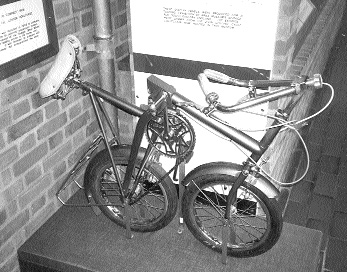

 Problems with space as usual, so we’ve expanded onto the internet. Don’t worry if you aren’t connected to the confounded thing – the magazine will continue on paper just as before, but we’re hoping to use the net to publish travel articles and items of general interest that would otherwise remain on file. E-publishing is not new, but we’ve listed the ‘shadow’ articles below, together with the ‘real’ ones, which just might be.The address is www.atob.org.uk/32/ plus the relevant page number below.There’s no security password, so these pages are available for anyone to see, but the index is in the magazine, just to annoy non-subscribers.

 All manner of sporty types tried their hand on this infernal machine, including cycling’s Mr Big, the Rightly Honourable Steven Norris, formerly a Tory MP, but now a professional transport lobbyist, supporting cyclists, motorcyclists, motorists, and any number of other ‘ists’, for a modest remuneration. Unlike the Lycra-clad types, Mr Norris proceeds to ride the Marin County Downhill Course at a nice steady A to B pace, as one might expect from a fellow with a reported loathing for bilious Lycra and daft cranium helmets. In any event, Mr Norris makes no secret of the fact that he finds exercise in other ways, and quite right too.
 Airframe probably had the nicest stand in the show – well lit, exquisitely designed, and displaying some cheerful- looking Airframes in a variety of fruity colours. One wishes the bike well – the wibbly- wobbly frame will not appeal to all, but the rideability and general sporty stance of the bike should produce sales. According to one seasoned observer, the bike actually rides better than the Birdy… it’s also somewhat cheaper.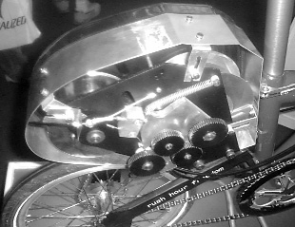
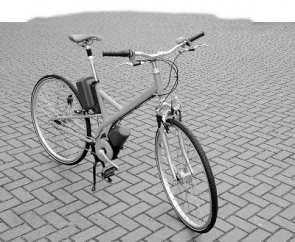
 The other crank-driven newcomer is the Oxygen, an Italian bike marketed in the UK by Pedal & Power of Chester. Like most Italian products, Oxygen marketing involves delightful young ladies wearing very few clothes. The Mole reproduces an example for the general good of cycling (see A to B 31), and yes, one appreciates that she couldn’t possibly cycle in those heels.
 The favourite amongst the Telly-Tubby fraternity was, as usual, the Like-a-Bike. These little wooden machines were underfoot throughout the show, despite the best efforts of the BDC’s burliest security guards. Sunday’s photo-shoot resulted in predictable chaos, when five diminutive riders converged on the A to B stand, through, between and under the crowds.The photo session was followed by a visit to the test-track, where a remarkably talented two-year-old led the field, but was pipped at the post when the A to B man took the inside line.
 Amongst the most interesting products at CYCLE 2002 was the ‘Ultimate Folder,’ brought over from California by Len Rubin to illustrate his lectures at the show.This machine is a Brompton- clone constructed almost entirely from titanium. Even with a 14-speed Rohloff hub, weight (without pedals) is 9.4kg, or a little over 20lb.The bike rides well and feels rigid, with the exception of the handlebar adjust mechanism – one of the few components that wasn’t made of titanium.
 Where do Moulton owners get their boundless enthusiasm? it takes a lot of nerve to self- publish anything, let alone a title as specialist as this.Where, one wonders, do they find the time? Do they do anything else?
 At last, a pocket-sized bicycle maintenance book! Strangely enough, if the Cycle Maintenance Introduction is to be believed, bicycles now come in three distinct styles – racer, tourer and, er, Brompton. Unfortunately, this radical start is tempered by a complete lack of information on said folding bike or any of it’s cousins. Hub gears get only the briefest of mentions, and although the book is copiously illustrated, the beautiful photographs involve the sort of brand names that you and I either dream about, or can’t pronounce, or both – Campagnolo, Colnago, Shimano Dura-Ace and so on.
 Encycleopedia was one of the big success stories of the alternative transport world. It didn’t take advertising as such, but manufacturers were ‘invited’ to sponsor their own page.The disadvantage of this system is that very small, very poor concerns can get left out, while big manufacturers producing utter rubbish get in. So all credit to McGurn, Davidson et al, that this didn’t happen in practice, presumably because the small fry were subsidised and the big ‘uns turned away.
 You commented in A to B 31 that the Lumotec light did not come on under trees/twilight. I have one fitted with the SON hub dynamo, and whilst the instructions were unclear, I found that it has worked very satisfactorily.The problem I have found is getting the rear light to work – I suspect earth connections.The rear light is powered from the SON hub through the Lumotec front light, but I have only used the live wire.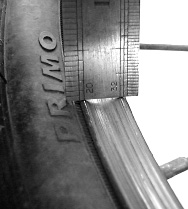
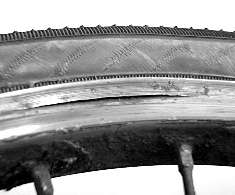
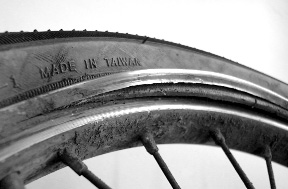
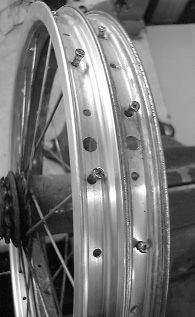
 The next stage is to check the vertical and horizontal alignment.To check this, you’ll need a fixed point, such as an old spoke mounted on a heavy block – slide the block forward until the spoke just contacts the high spots on the rim. The aim is to adjust the spoke tension until your fixed point touches the entire rim when the wheel is spun. If the wobble is up and down, gently tighten all the spokes at the high spot and loosen those on the far side of the wheel. If the wobble is side to side, loosen the spokes attached to the appropriate side of the hub, and tighten those on the other side.
 Most of the serious folding bike designs have gone out of production at some point: Brompton, Micro, Strida, Microbike, and so on, but the majority have subsequently returned. Some, like Peter Radnall’s little Micro, have performed the feat twice, but all – with the exception of the Swedish (then Japanese) Microbike – remain in production at the time of writing.
 The Airframe is quite unlike any other bicycle, owing more to structural engineering than transport machinery, which is what one might expect from an architect designer. The best way to visualise the frame is as a group of three triangles, with the usual cycle paraphernalia – wheels, cranks and chains – bolted to the extremities.The triangles look similar to a traditional diamond frame, but the principle is completely different, because almost every joint is hinged, enabling the triangles to fold into long thin triangles when the seat tube is lifted up. In use, the rider’s weight passes down through the seat-tube, transferring the load into the two top tubes, which try to make the wheels do the splits.They can’t, because the bottom tubes are in tension, holding the wheelbase and bracing the bottom bracket. In theory, the more weight applied at the top; the more the bike tries to do the splits; the more tension in the bottom tubes; and the more rigid the machine becomes.
 The gears are a bit disappointing for such a sporty machine, but we’re glad Airframe opted for hub gearing.There are few suitable hubs around at the moment, so the company has made do with the Nexus 4- speed.This unit can run with silky smoothness, but it’s hard to adjust, relatively inefficient and lacking in gear range. Our pre-production bike (by no means the final spec, incidentally) offered gears of 43″ (on the high side), 53″, 64″ and 78″ (on the low side).That 184% range is similar to the 3- speed Brompton, but rather less than the 215% offered by the Brompton 6-speed. Ironically, that bike’s close ratio hub/derailleur system might have suited the Airframe better than the Brompton, but there we are.
 The riding position is sportier than most folding bikes, with a saddle set well back and low bars. If you’re more used to a touring bike, and have rejected the Brompton for its upright stance, this will be more to your liking. For more services that will be more to your liking, visit
  Weight isn’t everything of course. A folding bike needs to fold quickly, easily and – most important of all in the long run – repeatably. The weakness with the Airframe is that despite Teflon shims, the joints are pretty stiff, making folding a chore, and it never seems to produce the same package twice. It’s also one of those three-handed jobs.
 For the Westcountry, at least, the situation is about to change, following some clever design work.Wealthier train operators are simply replacing the elderly Sprinters, but for the cash-strapped Wessex,Wales & Borders and Valley Lines TOCs, new vehicles were not an option. Instead, the decision was made to refurbish the 15 year old trains, at a cost of £75,000 a time. A few units have already been completed at Canton Depot in Cardiff, and the final trains in the 25 strong fleet should be back in service by Autumn 2003.
 The refurbished two-car units provide a mix of ‘traditional’ airplane-style seating, plus seven tables with facing seats, and 25 tip-up seats located close to the doors.These trains need to handle holiday crowds and peak hour commuter traffic (often on the same day), so the aim has been to provide plenty of luggage space where it’s most needed, but extra passenger seats when required.The area around the doors has always been spacious, but now for the first time, there are two tip-seats in each vestibule.
 The bike space is still there, but instead of a crude tip-up bench seat, the company has fitted three individual tip-seats on either side of the carriage. A bicycle still occupies three full seats, but several folding bikes or items of luggage can now be accommodated along with one or two passengers as required. And if a group of bikes are travelling at a quiet time, they can be placed both sides of the carriage – room for about six bikes in all.

 Ever experienced the classic cyclist’s nightmare? The one where no matter how hard you pedal, the horizon gets further and further away? Buy a Gekko and you’ll have a unique opportunity to experience the night terror for real.
 Yes, the rolling resistance leaves much to be desired, although it could have been a lot better had we been able to fine-tune the tyre pressures. We managed to adjust the front tyre (this wheel has a sensible tally of 16 spokes), but space is at such a premium in the rear wheel (28 spokes), that we couldn’t find a pump that would reach the valve. Fitting twenty-eight spokes to a 12-inch wheel might sound like overkill, but 28-spoke hubs are common on childrens bikes, so they’re easy to source and cheap…
 Our rolling resistance figure came out at 10.1mph, which is jolly good, all things considered, suggesting that 12- inch tyres (even 30psi ones) can be viable. But that sort of figure has to be compared with the results from the ‘real’ folding bikes, where even the 16-inch Brompton manages 14mph or more these days. So if you buy a Gekko you’ll not only be hampered by a cruising speed of 8mph on the flat, but you’ll suffer a 30% reduction in downhill speed too. Hill climbing is even worse, because the frame flexes like mad under load, and the saddle height is limited to 94cm, which is simply too low for most people. Clearly this bike is seriously challenged against the opposition.
 Maybe the smaller wheels allow it to fold smaller? Er, no.The Gekko hits the same brick wall that has stopped numerous folding bike designs in their tracks since the Brompton achieved a folded volume of three cubic feet. It might be improved on tomorrow, next year or in a future century, but then it might not, because below 20 inches, wheel size has little to do with folded size: the deciding factor is the frame, and it’s very difficult to make a full-size frame fold smaller than three cubic feet, sorry, 85 litres.

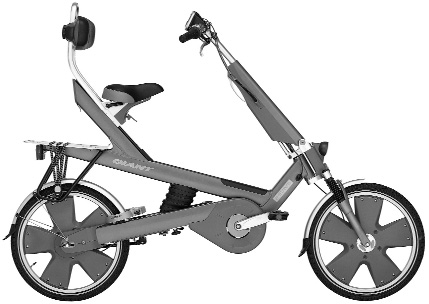
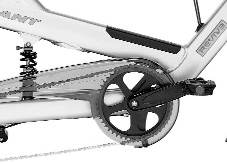


 The good news is oodles of adjustability.The saddle can be positioned anywhere from 58cm to 109cm above the ground, which should suit anyone from a very small boy (yes, Alexander had a go) to the world’s tallest man. Unfortunately, the handlebars are nowhere near as adaptable, so the small boy can’t reach them and the world’s tallest man would be delving around between his knees. But for 99% of the adult population, it’s fine.
 Even for a novice, the Frog is easier to fold than the Birdy, taking about 20 seconds or so.The finished package measures 62cm long by 49.5cm tall and 32cm wide.That’s a volume of 98 litres. In old-speak that’s 3.5 cubic feet: smaller than anything except the Brompton, which is taller than the Frog, but shorter and narrower.There are a few wayward cables, and the package only ‘sort of’ locks together, but folding remains pretty impressive.
 Don’t ask me why they named it Ridgecrest.There is no ridge and the town doesn’t sit on the crest of anything. Ridgecrest is a nice quiet community of some 30,000 people on the edge of a huge valley in the middle of the Mojave (mo-HAH-vee) Desert, about 190 miles northeast of the Los Angeles area, where I live and work.
 For the next three days, my routine didn’t vary. I started the day at 6am with a cool morning Brompton ride around the sleepy town, and then spent the rest of the morning visiting and asking questions.Afternoons – which in August mean 110 degrees desert heat – were spent in the motel reading The Third Act. Evenings brought more sightseeing after things had cooled off for the day.