
FIRST PUBLISHED June 2003: Bike Show, Round*Up 2003
In April the Mole braved one of Virgin’s new ‘compact’ Crosscountry trains to visit the Bike Show at Birmingham’s ‘International’ Exhibition Centre. According to the positive spin from Cycling Plus magazine, this formerly youth-orientated shindig was to be transformed into a mainstream (ie, CYCLE-style) show for 2003 and was thus worth a visit by those over 20. Approaching the hall with a crowd of sub-12 year old boys, one began to suspect that the hype might have got slightly ahead of the actualité.
For any elderly folk who might – reasonably enough – be drawn by the ‘Bike Show’ title in future years, the Mole can confirm that the event consists largely of noisy BMX displays, with a side order of mountain-style machines for the twenty-plus old-timers. In other words, it’s a dead waste of fifteen quid.
Leisure cycling is big business in the UK. According to the current What Mountain Bike? advertising rate card, the print run for this single title now exceeds 50,000, and the overwhelmingly male readership (94%), has an average age of 32, and annual income of £22,905.
 At the Bike Show, a selection of nefarious stall-holders were hard at work pocketing wads of cash from young men of this kind. One such outfit was Ebryo Scooters, purveyor of a monstrous electric scooter known in its country of origin as the Flying Dragon, but repackaged as the ‘Street Runner’ for the UK where dragons have less relevance in marketing terms.
The Mole took great delight – as one does when the opportunity arises – in informing the sales girls that this £500 machine (show special £400) was illegal on streets, pavements, cycle paths, or indeed, anywhere other than private land. And a little market research might have revealed this, saving a great deal of embarrassment.
Elsewhere, the Comfort Saddle company was busily steering bottoms onto its product.This ludicrous device looks rather like a leatherette bench seat, of the kind that made a brief appearance in early 1950s motor cars. Gentlemen of a certain age may recall that these softly-sprung wonders provided an unrivalled means of getting intimate with one’s passengers, but gave little in the way of support, should one not wish to slide rapidly across the car. This characteristic is all the more pronounced on a bicycle, where such and annual income of £22,905. At the Bike Show, a selection of subtleties as road positioning and hand gestures are accomplished – without putting too fine a point on it – by gripping the saddle with one’s nether regions.The Comfort is further hampered by a strange spring device that allows the saddle to flex, yaw and roll to angles that bottoms are rarely taken.
When the Mole expresses some mild scepticism, the Comfort apparatchiks claim that the saddle has been widely tested both on and off road, with no apparent tendency for riders to slip from their steeds.Thus, should any readers with flat non-slip bottoms wish to lighten their wallets to the tune of £39.95 plus postage, the means is now available.
Growing weary of bicycling in England, the Mole trekked 3,000 miles in search of enlightenment to Trophy Bike’s Round*Up 2003 folding bike show in Philadelphia, USA.
For those unfamiliar with foreign parts, America is very large, with many busy freeways and a considerable volume of traffic, all going the wrong way. Arriving a little late in the evening at Newark’s rather depressing airport (not unlike landing in a scrapyard), one rapidly establishes base camp at the North Elizabeth Econolodge, pausing only to look right rather than left whilst crossing the adjacent highway, which causes much cheerful honking from home-bound commuters. Incidentally, the Econolodge offers complimentary ‘donuts’ and coffee in place of breakfast, and a half-hourly courtesy coach from the airport, for those lacking the nerve to tackle US highway one by bicycle.
With bicycles now something of a novelty in the United States, a folding bicycle is akin to the sort of novelty that might fall from a McDonald’s Happy Meal.
Folding bicycles are not yet part of the American Dream, although the day of enlightenment might come, just as soon as the population is able to work out what they are for.Thus, the visitor tally at the Round*Up show proves something of a disappointment, particularly as many of the visitors turn out, on closer inspection, to be A to B readers, rather than folding newbies.
 Without exception, the select band of US A to B readers (literally one in million on the statistical evidence) prove to be a delightfully charming and urbane bunch. This is fortunate, for at Round*Up they find themselves face to face with a group of equally pleasant, but distinctly potty foreigners, who mostly appear to be intent on selling them folding bicycle trailers.
At around lunchtime on Day One, we make a soggy procession up Market Street, pausing only to retrieve bits of folding trailer sucked into the paths of taxicabs by the fearsome jetstreams of rain.
US mayors are made of strong stuff, but the Philadelphian incumbent takes refuge amongst his aides as our strange caravan files into a marquee on the steps of City Hall. There follow a number of the usual speeches – grateful thanks, shame about the weather, new era in transportation, etc – during which it slowly dawns that this is Philadelphia’s primary Bike to Work Week event, and our small group of potty foreigners is the primary exhibit. “…this is the primary Bike to Work event… and our small group of potty foreigners is the primary exhibit
Of local bicyclists we see none, although a number of advocacy groups have turned out, and they are all busily advocating this and that to the potty foreigners, who are trying to sell them trailers. Meanwhile, at the other end of the tent, the official stuffed shirts are calling for tolerance, in grim tones.
It appears that bicycle/auto relations have plumbed new lows in the city, although one doubts whether the average citizen would be able to recall the last time they saw a bicycle, let alone engaged in kerbside argy-bargy.
A number of bemused TV crews dutifully film the folding bikes folding and unfolding, and the trailers doing whatever it is that folding trailers do, before the mayor paints a small section of the rather optimistically-inclined bicycle mural, then legs it back to City Hall, leaving the foreign bicyclists to trudge gloomily out into the rain.

‘Wandering’ Hanz Scholtz and Lynette Chiang of Bike Friday

The mayor of Philadelphia works on the cycling mural
Days Two and Three prove equally entertaining, with talks from Bike Friday’s roving ambassador ‘Wandering’ Hanz Scholtz and marketing sidekick Lynette Chiang, who will need no introduction to long- term A to B readers.The following day, Airframe designer Grahame Herbert arrives, accompanied by his delightfully unflappable wife Lorraine.The pair have ridden for several hundred miles up the coast – a great success as proving runs go, but rather spoilt by unfavourable road conditions.
Cycling in the USA varies, just as it does in overcrowded Britain, although minor roads are generally quieter and less frenetic, if you can find them. Bulky Sports Utility Vehicles are more common of course, as are stretched limousines and other More colour images at oddities.The latest cult urban attack vehicle is the military Humvee, and its almost unimaginably daft cousin, the stretched Humvee. Yes, for a trifling sum, you can hire one of these monsters and terrify your friends. Or join the mercenary business. Stretched Humvees make an entertaining sight, provided you don’t intend to cross the road.
Urban coup d’état chic is nothing new, but where Brits cheerfully make do with a pair of battle fatigues and an artfully arranged scarf, the Yanks go in for more serious hardware. Love it or hate it, there’s a certain style there.
As US vehicles grow ever larger, so do their occupants. This appears to be an uneven process, for the majority (including 100% of A to B subscribers, naturally) are pleasantly, or at least reasonably slim, but some 20% of the population is now reckoned to be clinically obese, against a piffling 12% in 1991. In a recent US government survey, 27% of recipients admitted that they ‘did not engage in any physical activity’, beyond (one assumes) keeping blood flowing around their vital organs. At the risk of being terribly obvious, perhaps the US should rediscover the bicycle in a hurry?
 Should one have time to kill in Philadelphia, the SS United States is well worth a visit. Built in the 1950s, just a decade before the horrors of air travel destroyed the elegant liner trade, the vessel is a rare survivor.Withdrawn from the Southampton to New York run in 1969, she changed hands a number of times, circling the world from shipyard to scrapyard and back, as each project foundered. Finally, stripped to the bones internally, the great liner came home and has been moored on Philadelphia’s Delaware River ever since, awaiting restoration… or the scrapyard. One hopes that one of the various projects will eventually succeed.
…the yanks go in for serious hardware. Love it or hate it, there’s a certain style there…
For liner-geeks, the United States had turbines of 240,000 horse power, offering an unmatched power to weight ratio, and a top speed of 43 knots, or 50mph. She was, however, a tiny bit shorter than the France (now, rather confusingly, called the Norway), or our own dear Queen Mary or Queen Elizabeth, but we shall not dwell on such trifles.
Would today’s jaded air travellers be willing to swap jet lag and deep vein thrombosis for more relaxed travel, one wonders? The market for cruise liners is growing rapidly, but it’s hard to imagine today’s business traveller swapping a six-hour flight for three or more days at sea. Perhaps the liners could be marketed as enforced health camps, offering their captives three days of unrelenting pain in exchange for a few glasses of carrot juice.
 But enough of what might be, for we must journey to Scotland, which is visibly pulling clear of our increasingly dis-United Kingdom in transport terms.The latest innovation from north of the Border is a pro-cycling advertisement:Thirty seconds long, the film makes a mockery of those annoying car ads where square-jawed young fellows get the crumpet by driving much too fast on remarkably empty roads. In this memorable example, our hero takes to commuting by bicycle, arriving faster and very obviously getting the crumpet in the shape of a pair – no less – of voluptuous cycle courierettes. Cycle commuting has been on the rise for some years in urban Scotland – up 38% in Glasgow and 65% in Edinburgh during the 1991-2001 census period. Just watch it accelerate now.
It’s hard to imagine anti-car advertisements in a totalitarian state such as England, of course. But in those provincial pockets where the grateful citizenry has cast off the New Labour yoke – London, for example – things are going a little better: A combination of central zone Congestion Charging and widely distributed cycle maps has increased cycle use in central London by 16% in a matter of weeks. Mayor Livingstone, bless his heart, is now enthusiastically pushing for the Charge zone to be extended westwards, with 20mph limits on most residential streets.
Yet even in the capital, research by Transport for London has found that 38% of non- cyclists are ‘worried that friends will laugh at them’ should they try cycling. A case for TV advertising, surely?
But we shouldn’t believe everything the authorities tell us. Readers may recall the graph in A to B 30 drawn from Department for Transport statistics, showing cycle use plummeting by more than 10% in seven years. Following a mysterious hiatus, the figures have been reissued as a 10% rise in the same period.Well, fancy that! But wait…. in the same bulletin, provisional results for early 2003 are indicating a renewed and even more catastrophic fall of 11%. Sometimes you just wish Tony would make up his mind!


 “I’ve always been interested in the idea of solar-powered transport, but no-one seems to have built anything practical yet. Is a solar vehicle a practical proposition in the UK?”
 The bad news is that solar panels are generally unsuited to use on bicycles. Although the panels themselves are light, they’re fragile too, so they’re usually housed in a heavy rigid frame.A few lighter, flexible panels are produced for boats and mobile homes, and although these are not particularly space-efficient, we must concentrate our search in this area.
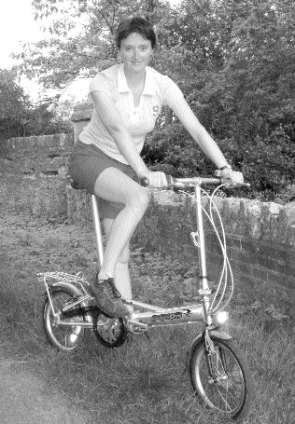
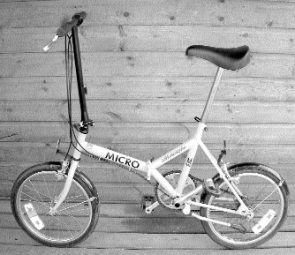
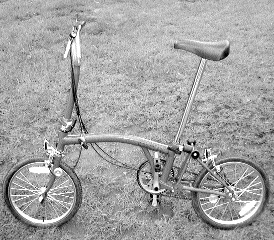
 None of these bikes are great hill-climbers. Despite a bottom ratio of 44 inches, the Brompton does best, because it’s rigid enough for you to stand out of the saddle on steep hills.With a bottom gear of 40 inches and a reasonable frame, the Dahon isn’t far behind, but the little Micro is limited to the sort of gradients that can be climbed with your bottom very firmly on the saddle. Standing out of the saddle on a Micro is an acquired art, and not an especially productive one.Top speed depends on how fast you can twiddle the pedals with a 75-inch top gear (Micro and Presto) and 82-inch gear (Brompton).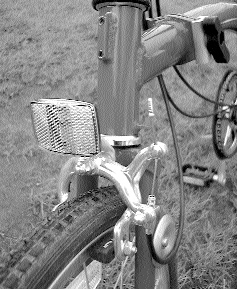
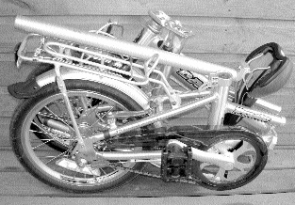
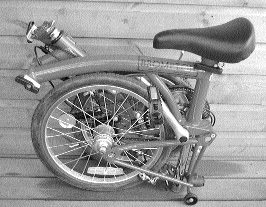
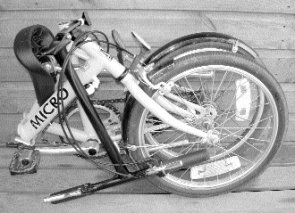

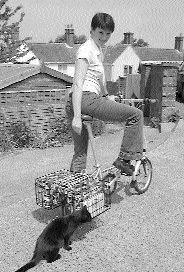 If you do practical things with a bicycle, like shopping, you’ll know all about panniers – those gloomy bags you can’t live with, and can’t live without.When you need them, they’re usually too small, and when you don’t, they’re invariably too big. So, how about folding panniers? A very A to B solution, we thought.
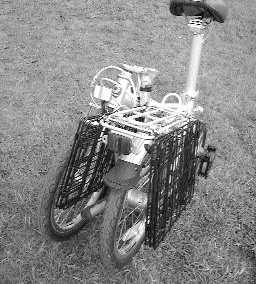 The theory is admirably simple: a pair of metal baskets with hinged bases and sides. For 90% of the time, the panniers are wind-cheatingly slim, but get to the supermarket and – flick, flick, flick! In a few seconds, you’ve created two rigid containers measuring 18cm wide by 21cm deep and 32cm long. Oh all right – 7″ x 81/4″ x 121/2″ in real units (yes, we’re reverting).That’s big enough for 16 tins of cat food plus a box of Friskies each side – a total load I of around 13kg.
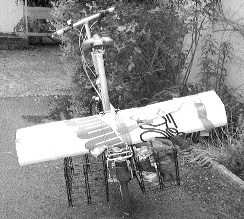 Any disadvantages? The panniers are heavy (2.4kg the pair), and they can be noisy, particularly when empty, but a well placed bungee cord should solve that one. There’s no protection from rain or pilfering either, but no-one ever claimed they were suitable for touring. Longevity? Hard to say, but these are the sort of extras that can be reconstructed with a pair of pliers and a twist of copper wire. Speaking of which, we found the crucial clip that holds the assembly shut needed a bit of tweaking, and the mounting clips were happier on a thin steel-framed rack, although they worked perfectly well on a modern alloy rack with 8mm stays.
 Tests of ‘conventional’ big-wheeled bikes are rare in A to B, because we prefer to concentrate on more interesting things, but the concept of a really well-equipped commuter machine was quite tempting.
 Gears are either Shimano 2×9 derailleur or – much more interesting – a SRAM 7- speed hub.The German-made SRAM 7-speed is probably the best multi-gear hub (and will remain so unless the Sturmey 8 proves to be very good indeed). Since the demise of the frail but elegant Sturmey Archer 7-speed, the SRAM’s only competitor has been the Shimano Nexus, which it comprehensively outshines, whatever your local Shimano agent might say. Gear range is wider (284% against 244%), efficiency is higher, particularly in the low gears, and wheel removal doesn’t involve blood, sweat and tears.
 The most interesting technical advance on the Orbit is the state-of-the-art lighting system – Nexus automatic hub dynamo, Hella FL980 front light and Basta automatic tail light. Our first taste of auto lights (see Giant Lafree Comfort, A to B 31) was less than satisfactory, because the Nexus system would only turn itself on after a stop, which made it useless for tunnels, or gloomy avenues of trees. On the Orion, the very similar system works perfectly – the hub absorbs little energy during the day, but as soon as the detector senses low light levels the front lamp clicks in, and stays illuminated for as long as required. That might be ten minutes, or all night – no dynamo to work loose or seize up, and no batteries to replace.
 Would we now recommend auto lights? Once you gain confidence that the lights really will do what they’re supposed to, this is a good system and a great safety feature. Few cyclists bother to stop and turn on their lights in heavy rain, or generally poor lighting conditions, but most motorists do, and quite rightly so.With the Nexus/Hella system, the lights are always ready for action.
 Otherwise, accessories are a bit thin.The bike comes with Pitlock skewers (see A to B 34) to help keep all the expensive components in place, but if you’re a forgetful numbskull too, you’ll be constantly leaving the key at home – big problem if you need to remove a wheel or lend the bike to a shorty.
 We test bikes with big wheels and we test bikes with small wheels, but we don’t often test machines with a big wheel at one end and a small wheel at the other. No pedals either.
 The gear ratio depends on the length of your legs and how muscle-ly your thighs are. Initial acceleration is well up to hub gear standards, but speed rapidly tails off, where a bicycle keeps accelerating.The practical terminal velocity on the flat is around 7mph, although ten is manageable for short distances, and speed can sail up into the twenties on steep down grades, especially if you have the nerve to squat down and assume a wind-cheating position behind the front wheel.The ideal situation is a gentle down gradient.We recorded a reasonable rolling performance of 14.5mph on our test hill, which is about half way between 18-inch and 28-inch performance, less the extra wind resistance from standing up. Progress on the flat can be reasonably sprightly too, with a following wind, but going uphill is hard work, even on modest gradients. If you’re not used to the kicking action, you’ll be doing a lot of walking.
 The turning circle of the Kickbike is much greater than a small scooter, and big even for a bicycle, which is rather disappointing. It can be turned in three metres, which is adequate on the road, but rather cumbersome on the pavement. Manoeuvrability is also hampered by the lack of a saddle, because on a crowded pavement you can’t easily swing the bike around.The technique is to hook your foot under the frame and lift it round.
 We’ve talked about the evolutionary aspects of electric bicycle development before. And, love ‘em or loath ‘em, the early years of this new century provide a fascinating opportunity to observe transport evolution in progress. Broadly speaking, electric bikes have split into two groups; the heavy Chinese bruisers, personified by the Powabyke, and the newer gazelles of the genre – light, agile pedelecs, such as Giant’s Lafree.
 Typical of Far Eastern electric bikes aimed at Germany and the USA, the Forza has a saddle as broad and flat as a dinner plate, with modest height adjustment of 86-89cm, even before the suspension post has sagged under those decadent western buttocks.We did manage to twiddle the saddle up to 96cm by ignoring the ‘max’ warning, but for those lucky enough to sport a slimline Euro-bot, and lovely long legs, this sort of thing is a bit of a joke. It will also more or less guarantee knee damage, should you put any great effort into the pedals. Forza tell us that production versions will come in two frame sizes.
 The suspension forks and seatpost are not of the best quality, but they do a manful job, coping with most road conditions. Actually, a fair bit of the resilience seems to come from the chunky 26″ x 1.95″ Kenda tyres, which are knobbly on the edges and smooth in the middle, in true ‘mountain-style’.The bike would go further and faster with narrow high pressure tyres, but it might not be so comfortable.


 Hardly a day goes by when we don’t grumble about the lack of bicycle trailer awareness in the UK.The Dutch and Germans love ‘em, or so we’re told. On the Continent (and, to be fair, in some more enlightened pockets here), the School Run no longer means heaving a tonne of Volvo into a queue of other Volvos, to drop your tiny charges in the ‘Strictly No Parking’ zone outside the school gates, but a quick and hopefully stress-free cycle ride.
 By the time a Chariot trailer arrives in your local cycle shop, it has done a fair old mileage.The trailers are manufactured in Canada, then shipped to Germany for distribution by Zwei plus Zwei. In the UK, trailers were formerly sold through Two plus Two, the trailer specialists in Lewes, but new distributor Amba is aiming to take on board a number of regional shops too. By and large, that means the sort of outlets that advertise regularly in A to B.


